Showing posts with label tetard. Show all posts

September 22, 2012

A passion for Trognes

On a Monday night in September 2012 we went over to La Rabiniere at Betz-le-Chateau to a book talk organised by the "Champs des Livres" association.

The author was a man passionate about "Les trognes" which is the main title of his book.
The passionate man was Dominique Mansion who founded and runs the Maison Botanique at Boursay in Loir et Cher.


I pollarded our old willows because I love trees and knew that they were old and needed a haircut...
I was also aware of the wildlife that a pollarded tree supports...
but my knowledge pales beside Dominique's!
He spoke of the history of the pollard, the reasons, the wildlife...
he spoke quietly, intensely and with burst of loud emphasis.
He was utterly captivating...
so much so that I would have bought the book afterwards...
if I hadn't already bought a copy as we went in!!

After the talk he was doing signings...
and I asked him to dedicate it to "The Pre de la Forge" as we've recently registered the main part of our land as a reserve with the LPO.
What I hadn't realised was that he would do this...


The book dedication and a quickly drawn picture
Everyone who asked for a dedication got a sketch... every one different!!

He has also brought out an "Agenda" for 2013, so I bought a copy of that too...
not to use as a diary...
but a book to record what I've been doing to and finding in the field.
His illustrations are marvelous...
both detailed where needed and beautifully freely drawn where the impression is what counts.

Agenda [or diary] for 2013

The trogne goes back to prehistory...
the oldest example of a pollard was found on the bed of the River Trent and dates to 3400 years BP [before the present]...
which makes sense as a store of shafts and rods would have been needed then as now.
Pollarding, or coppicing, may well have developed earlier than this...
as man observed the way the trees regrow after being cut....
or, as stated in this book, after beavers had been at work.

I have used the term 'trogne'...
this is a French regional word for a pollard...
and, because he was told off, as a schoolboy...
for using "patois" in an essay, when the accepted French term is tetard...
he maintained an interest in the trogne and has now documented in this wonderful work...
the history...
the reasons...
the types...
the products...
the by-products...
and the wildlife associated with pollarded trees.
Well done, that teacher!!

This year, I started the first new 'trognes' in this meadow...
which are already providing cover for birds and food for insects and their predators.
In two years time, I will make the next batch....
in three, I will recut this years...
and also the first of the old ones.

And, in the meantime, the willow species that I have planted here will become trognes...
cutting rods at waist height is much easier than coppicing.
There will be some areas of coppice though...
because as a method for harvesting wood, it supports other species and a different flora.

But...
there are trognes everywhere in this region...
in every vineyard at least one Golden Osier glows in the winter sunshine...
providing a source of flexible rods for the vignerons.
However, the old pollards...
especially the willows...
are as neglected as ours were...
loosing branches and dying slowly...
until they get grubbed out to make the landscape tidier...
removing not only the habitat they provide...
but history.

March 22, 2012

Five old Saules... part four of the saga - 2008


Making a start...
removing the small and dead branches.

The routine continued... but like last year we had my wife with us, so Stuart and I were able to crack on much quicker, leaving Pauline to cook and clean up after us!
Well, not really...
the third pair of hands actually meant that some of the more difficult tasks were...
"three head, six hand" jobs.


Lopping the easy branches first to clear the view.
And that was really useful...
especially when we hit a big snag...
the last trunk to fall.
It had a twist...
and didn't give any indication of a bias to fall any particular way.


The last three branches...
the last one is the furthest left...
with a great big double bend!

So whilst I stood and looked, and paced around the tree.....
and stood and looked, and paced around the tree.....
Pauline kept me supplied with coffee and helped Stuart shift the timber from the first branches that we'd dropped.

Eventually I decided to rope guide the direction of fall.
That meant getting a rope around the trunk as high as possible...
higher than I could get with the ladder.
There was a group of three branches slightly lower than I'd have liked to position the rope...
but they were reachable with a hammer throw.

A strong string attached to the hammer, it was hurled violently upward towards the first branch of the trio...
and my aim was good.
Yes, I hit the branch square on!!

Second try missed it perfectly and the string was over the first...
and by sheer luck, the second.
Fate was sitting up there watching....
and having a good laugh....
I hit the third branch a glancing blow and the hammer fell....
back over the second branch!
Threw it back over the second branch on the third attempt....
and eventually the third!!
The rope was then hauled over and round, a slip hitch tied and it was pulled tight to the tree.

Because I didn't have a winch of any sort, the other end was anchored near the bief...
a metal bar was then "looped" into place about halfway between the two anchor points.
We attached three long butt-ends of the other branches to the rope...
just above the metal bar...
as it took Stuart and I to raise the ends into position whilst Pauline tied them into place...
I would estimate that we had the pulling power of about four people at that point...
but in the form of undamageable logs.

I was cutting from the back of the tree which meant that I was going to be higher up than the bole... this was alright by me...
it meant that I could cut straight through, with just a shallow sapwood cut lower down to stop the bark tearing.
Once felled, I tidied up by doing a second clean cut to finish off.

A tidy, cleaned up bole and a stack of firewood.
The darker wood is a previous years harvest.

Job's a goodun...
all five trees pollarded [tetardé]

The view with all the trees pollarded.

Then, after the last bonfire....


The smoke from the last bonfire drifts Eastwards across the meadow.

....it was back to tree planting...
mainly extending the areas we had already worked on...
and getting more young twigs into the tree nursery.


The view of the nursery area from the kitchen window.

The row of trees nearest the bief are waiting to be lifted.
There are three trees in the green binbag, waiting to be planted out...
some root loss was unavoidable, but as before...
we compensated by planting deeper.


The duckboards over the already dug soil can be clearly seen in this shot from the bridge.

The duckboards allowed us to dig the trees out without us getting bogged down in the soft mud.

Once all the trees were out, new rods were planted behind where you see the duckboards...
in virgin soil...
this is to allow time and tide to refill the 'used' area.

Other small and specimen trees, including some Scarlet Willow...
and a spawn of the Headingly "Original Oak"...
were planted out in the verger.


The nursery bed in the verger for the smaller and specimen trees.
The "Original Oaks" are in the blue-green pot.

February 20, 2012

Five old Saules... part the third. 2007 and the heat is on!!

By this point Stuart and I had got into a routine.
Cut the 'trees' off the top of the old pollard....
deal with the usable timber, plant trees, cut rods...
and refill the cattle splash.

Why 'trees'...
mainly because that is what they were...
pollarding usually takes place between ten and twenty five years after a cut...
only really dependent on what wood you are trying to harvest.

With the final tidying of the tree nearest the bridge I was able to take a nice oblique slice at the base of one of the branches and this made counting rings easier....
all forty-one of them....
the trees were last 'tetarded' in 1964.

This tied in with the old 'milk record' books that we found....
the milking and managing as a farm ceased in 1985.
The twenty-five year cut would have been due in 1989 and, by this time, the owner was using it as a holiday home a couple of times a year.
The farm was managed, the owner was a 'pub landlord' in Poitiers.
So no one bothered.

We want firewood...
so will probably take a second cut at ten years from  the four strongest [2015 to 2019].
I am now thinking of using the weakest one, that we cut in 2006, as a source of rods....
it also seems to be a slightly different colour to the rest.

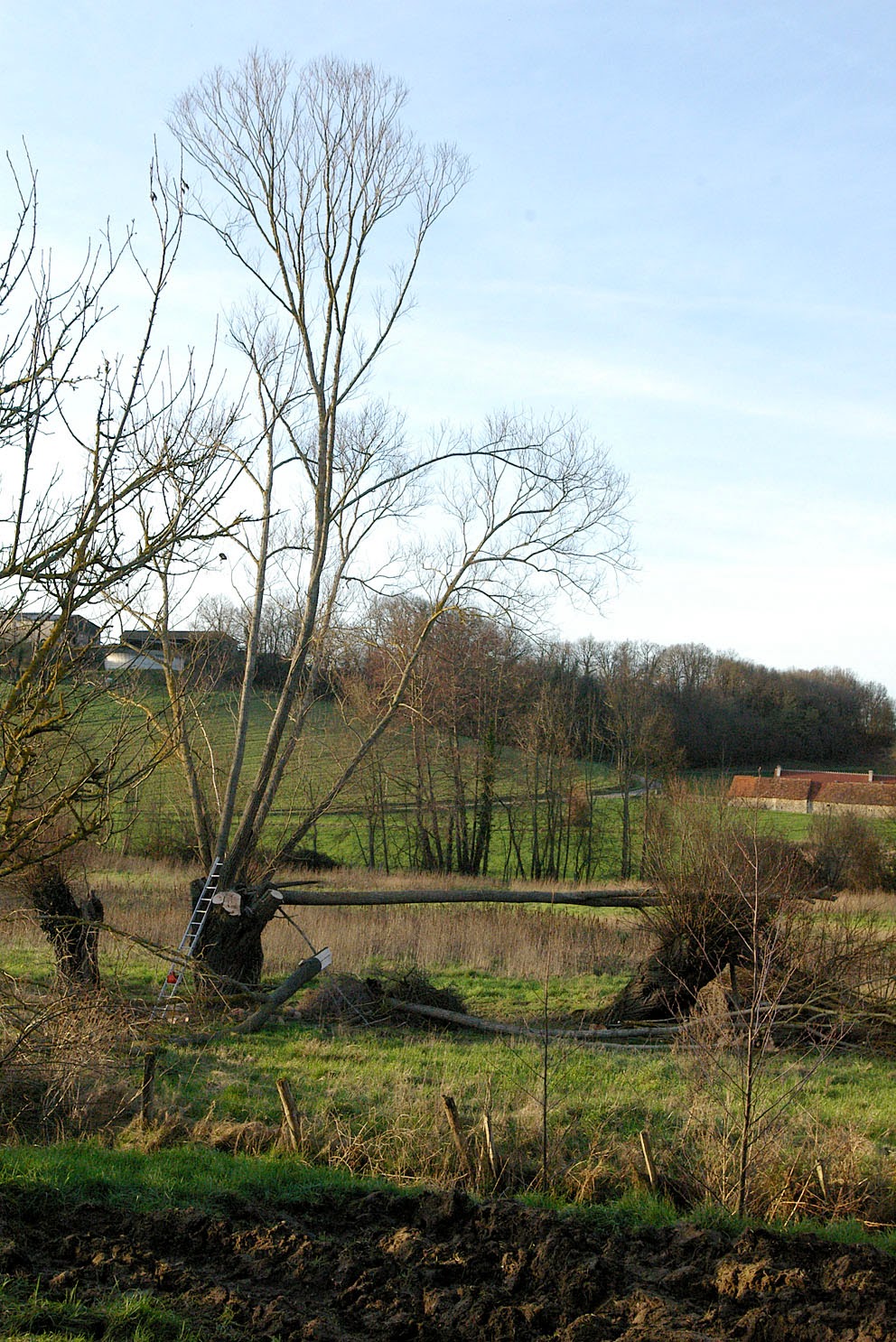
We chose the second tree from the bridge as this year's 'victim' and proceeded to drop branches.
The method was as follows...
cut down an outward leaning 'trunk', process, stack and pile the 'lop & top' up ready for burning.
All progressed well but...
not for long.

The fourth branch twisted slightly as it fell, and landed, absolutely horizontal, on the first tree...
fortunately for us, it landed inbetween the two growing points!!

The snagged branch, lying across the space...
would make a good hammock spot?

But it was still attached. How to deal with that?
My proceedure was as follows...

I started by cutting off all the branches furthest away...
until I arrived at the 'snag' point...
the first pollard...
unfortunately I didn't think to take photos...
I was too busy trying to get the branch down!

Rope two fully extended Acroprops just forward from the butt end to form a tripod.

Cut out the section beween the props and the tree...
leaving the trunk supported at the props and the first tree.

Stuart and I then pulled the two Acros away [using ropes], until the trunk reached the ground safely.

Undercut the trunk in sections until the end that was resting in the first tree was almost upright.

Climb ladder resting on first tree and with a Y-pole push the last length over...
snag removed.
Safely!


Final cuts made, it was time to tidy up.

All timber cut, stacked under tree 1 and the whole area tidied.
It was then OK to fell the rest, section them and stack the good timber up to dry
When the last branch had been dealt with in this way, then it was time for a bonfire.


More timber stacked on right;
Stuart by the bonfire and the area of branches in the foreground
is creating a habitat for insects, birds and small mammals.

As the fire got going so did the heat...
you can see the haze in the top left of this picture.

Once we'd cleaned up, it was onto the tree planting.
We had had a greater success with the young rods, about fifty percent take...
but lost a lot as a result of our infrequent visits in the height of summer.
Yes! I can hear you gasp....
"house in France and they don't use it in the summer?"

Well, no we didn't, we had 600 sq.yds of allotment to take care of in Leeds!
That was feeding us [on the veggie and fruit front at least] and needed tending to almost constantly.
We hadn't lost, however, more than three of the rods that were crammed into the 'cattle splash' nursery.

We left the 2007 rods in the now 'less than temporary' keeping pond and began to lift the young trees from the nursery.
Using a sharp spade, I cut down through the roots between each tree, one at a time, and then Stuart would pull it over and I'd cut through the tap root and we'd get a bin bag over the root block.
Once we had a barrow load [about half a dozen trees] we'd then move on to planting them.
We weren't precious about this....
it was...
[i] dig a hole large enough to get the root block into comfortably and about ten centimetres deeper,
[ii] stuff root block into the hole,
[iii] back fill and stomp heavily to firm the tree in and pile what didn't go back in around the tree.
No staking, no feeding, no nice compost...
they were on their own, planted about twenty centimetres deeper than they had been in the nursery.

We used these to 'beat up' the 2006 failures along the ditch towards the house and add to the two  survivors in the clump.

Next it was 'beat up' the line along the bief and extend it towards the 'Five old Saules'.
Once that was done we crammed eighty new rods into the nursery and put the rest out into the original two areas from 2005 to extend those.

As you will read in the next installment of the saga, we stuck to this routine for 2008.

November 20, 2011

Five old Saules... the second part. 2006.


As I said in the December 2010 post [now almost a year ago]...
we started by pollarding the big pollards already on the site.
The plan was to tackle them as 'one a year'....
but that slipped away after the first attempt with bowsaws.

The first willow to be attacked… as it was left in 2005.
You can see the healthy new rods that have grown during the previous twelve months.

2006 saw us 'armed' with a chainsaw.
That meant that we were able to tidy up the wreckage of the first attempt and finish the tree off properly.
The cut timber was then processed and we took some of it up to the hangar [dutch barn/open barn] to dry out for use as firewood.
The usable rest was stacked at the base of the tree. 


The first tree, once cleaned up, with wood stacked underneath.
The branch underneath, leaning against the trunk is not supporting the tree...
The tree lifted towards the upright and the branch fell away

We then tackled a second tree, the smallest and weakest specimen.
That way we were keeping to the original one a year plan!

Two views of the weakling - halfway through and after.
In the background of the first picture the maintenance tasks can be seen lurking.

Some essential maintenance followed on the remaining three trees....
cutting down dead branches and ones that were left unprotected as a result of the other work done.
 
First three trees pollarded.... hope for the weakling was faint!
The final tidying up on the fifth tree is yet to be done.

As we were less than halfway through the stay, and the fact that...
[a] the cut ends from the previous year had produced good growth and...
[b] the maintenance work on the third tree in the line had left only three good trunks coming up from the head...
we decided to do a full job on that one too.

In 2005 an attempt was made at planting up with first/second year growth from the top of the tree....
what a waste of time that was.
We planted 100 little twigs...
half at the end nearest the wier and the rest in the corner by our neighbours etang and the Aigronne.
We had six survivors at the wier planting....
and two at the lake end. Eight percent success rate!
Or should that really read...
92% FAILURE rate?

However, in 2006 we took a different tack.
There were plenty of really healthy first year rods to be harvested from the untidy ends that we'd had to leave in 2005.
We cut these off before tidying the ends and finishing the pollarding of tree one.
There were over one hundred and fifty one metre to two metre rods.

We placed these in a 'holding pond'...
hastily constructed at the side of the bief...
whilst we concentrated on the pollarding.

Rods stacked in the holding pen before planting.
This kept them wet and safe from being trampled on.

In 2005, I had used the cattle watering shallow to plant some currant bush cuttings that Pauline had taken from our allotment bushes.
30 of them were Redcurrants... probably Jonker van Tets... and 27 of them took.
There were hardly any losses from the White and Blackcurrants either!
[We now have twenty-seven redcurrant bushes in the verger! Ask Pauline....]

Armed with this knowledge...
Stuart and I planted fifty of the rods in a block next door to the thriving cuttings.
Most of the rest were planted at the lake end, in the original block and a group of three opposite...
next to the bief [to start the tree line]...
and at the wier end.
The last few were lined out along the ditch that leads up from the Aigronne towards the bridge...
and a small clump planted between the end of the ditch and the bridge.

As I will tell in the next posting... we had more success from the healthier, longer rods.